
📚😶🌫️ Our Next Book Club: Against Identity by Alexander Douglas
How to quit trying to find "your authentic self" and embrace an endlessly creative mystery.
“The ethical ideal is not to replace a conformist identity with an individual one. It is to get rid of identity altogether.”
– Alexander Douglas, “How To Be Yourself When You Have No Self” at Aeon Mag
TL;DR: Next up for the Humans On The Loop book club is Against Identity: The Wisdom of Escaping the Self by Alex Douglas — a timely and poetic text on a vital thread through the works of Zhuangzi, Spinoza, and Girard. Here’s a good review.
We’ll talk about why identity politics is both so stubbornly persistent and also so violent and maladaptive. We’ll explore the philosophical basis for a truer relationship to fundamental mystery, and what it offers us as humans and as society.
Scheduling poll for paid subscribers below the paywall, and some context and appetizing supplementary links along the way.
I record an episode with Alex tomorrow, and members will get pre-publication access to that before our call, along with a link to a free e-book. We’ll also open an async, pre-call discussion channel in the Future Fossils Discord server.
If you’re not already swimming with us, come on in! The water’s fine:
This summer at The Diverse Intelligences Summer Institute I spent as much of my time in St. Andrews as possible soaking up Topping & Company Booksellers, an absolute Mecca for bibliophiles where you can’t reach the top shelves without a ladder and they serve you tea while you browse. I brought a suitcase full of new acquisitions back to the USA after the workshop, and of those, the most notable volume has to be Alexander Douglas’s Against Identity: The Wisdom of Escaping the Self.
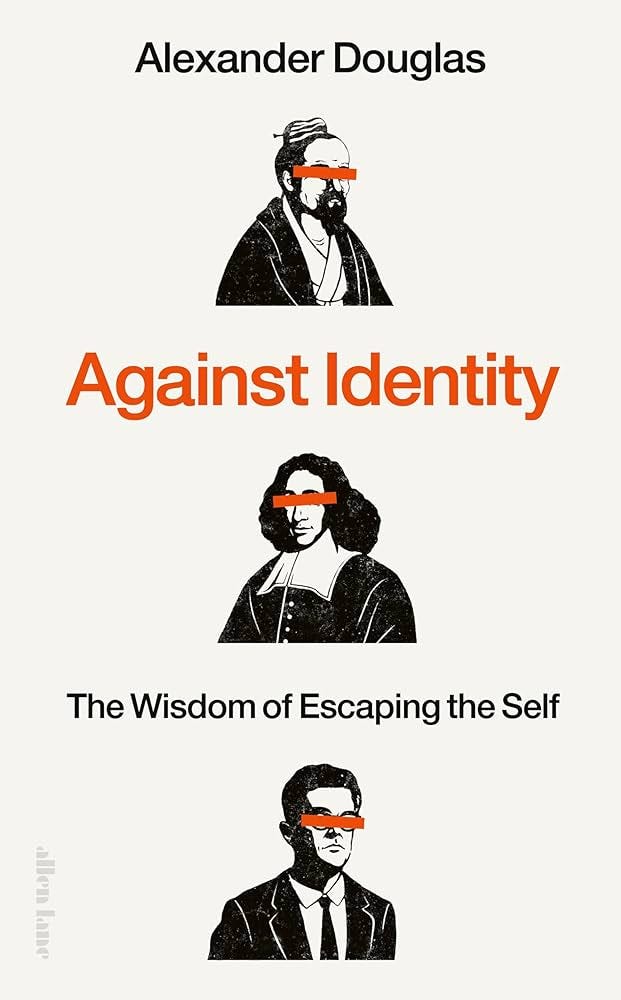
If you’ve followed me for a while, you know I see this kind of thing at the very heart of sense-making for life in the 21st century: challenging our conceptual categories and scientific models, reconstructing ideas of autonomy and freedom, advocating frameworks that introduce more nuance to our tired and inadequate ideas of “nature” and “culture”, reporting on the emergence of a radically different selfhood more well-adapted to our age of biotechnology and intelligent machines.
What Douglas does, and what endears me to this book so thoroughly, is to trace this kind of thinking back through the ages and examine how this strain has emerged time and again as a response to the collapse of prior worlds and their sociocultural identity regimes in ancient China (through Zhuangzi), on the cusp of the European Enlightenment (through Spinoza), and during the emergence of electronic media (through Girard). The book is eminently quotable and enviously lucid and accessible…the kind of read I want to stick in front of every loved one who has ever looked at me cross-eyed after one of my unhinged rants and asked, “What the HELL are you talking about?” And so it feels like the perfect substrate for our next reading group.
Here’s a quick hit of why all this matters from Douglas’ aforementioned Aeon essay:
I see examples everywhere of how identity holds us back. In a complex and unpredictable world, nations need more than ever to learn from each other. Instead they are closing their doors to foreigners and going into international dialogues with megaphone on and earplugs in. In modern democracies, people vote for who they are, not what they want, as Kwame Anthony Appiah puts it, leading to policies that pit identity groups against each other, rather than pursuing collective benefits – or indeed even real benefits to any one group. Information technology puts the whole world at our fingertips, yet people remain shockingly incurious about anything that goes outside their own narrow cultural sphere – as if fearful that exposure to too much difference will detach them from their treasured identity. And even when current patterns are shown to be unsustainable, we find it difficult to change them, due to our identities becoming somehow bound up in them.
Whet your appetite for our upcoming conversation by reading the whole (short!) thing.
Normally I’d send readers to grab a copy through my reading list at Bookshop.org (where you support indie booksellers and I get a small percentage of the sale) but it’s on backorder there, so Alex suggested going through Blackwell’s as the best retail alternative to Amazon. Or take your pick on the Penguin Random House site if you are as committed to marking up a physical copy as I am.
But also! For the first time, an author has been generous enough to link book club members to a free (albeit DRM-controlled) ebook at Netgalley so we all have immediate access. Members will find that link below, along with a scheduling poll for when to actually host the call. And don’t forget to join the Future Fossils Discord server if you want to riff on it before we riff on it.
In the meantime, Alex has an excellent Substack I recommend following here.
Excited to dive into this with you soon! Thanks again for your attention and support.
