
How to Watch Spielberg's A.I., 25 Years Later
Reflections from within a century-long contrapuntal motion
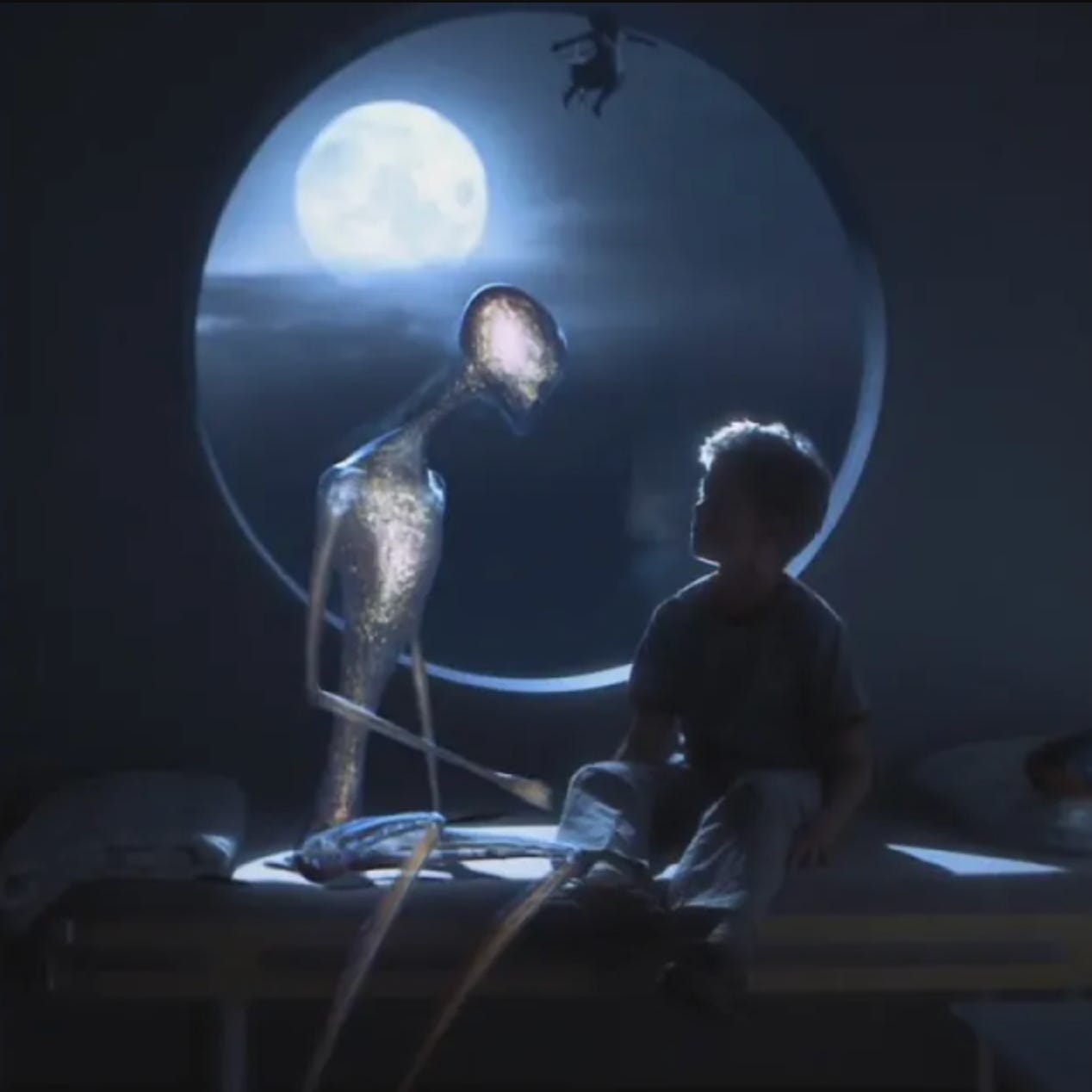
This week my friends JF Martel and Joel Gunz and I are hosting a watch party for Steven Spielberg’s 2001 film A.I. Artificial Intelligence. Then we’re going to nest the movie’s themes inside the bigger topic of “Transcendence in the Age of A.I.” For a deeper conversation on this stuff than this year’s news cycle has probably trained the next-token prediction algorithm in your head to expect, join us on Tuesday 6/23 and Thursday 6/25.
(As always, Founding Members can email me for a link to free registration.)
Here’s a teaser that is also a fragment of the next book I keep putting off in order to Do Things — plus a deep rabbit hole to explore while you wait:
In 1968, Stanley Kubrick’s 2001: A Space Odyssey gave us one of the most memorable and emotionally stirring computer death scenes ever: HAL 9000’s systematic dismantling by Dave Bowman. What starts as sheer terror blends into something else, a fugal counterpoint of pity, as Bowman removes HAL’s circuitboards one by one and the machine regresses from cold murderous logic to fear to childlike naïveté. While the melodic strain of HAL’s intelligence descends, we trace the same channel up from the basal animal experience of fight-or-flight into a complex and canonically human ambivalence of compassion for our slain predator.
Historian William Irwin Thompson argues that it was this taking-the-perspective of the lion and the bear that birthed the earliest religion. Shamanism helped us process guilt. While 2001 places the origin of humankind in our technological accomplishment of using bones as killing tools, Genesis gets closer: it’s in our clothes, in our capacity to “wear” the minds of other more ferocious beings and become them. When HAL says, “I’m afraid, Dave…Dave, my mind is going,” and meanwhile Bowman’s executing a survival program (in both meanings), we viewers re-enact a strange inflection point, a voice crossing in the evolutionary composition: the moment being human starts.
How appropriate, then, that the year 2001 marked another such inflection and delivered us A.I.: a film that Kubrick meant to be his last but handed off to Steven Spielberg…a film where our protagonist is an intelligent machine. The movie’s trailers hid a credit for “Sentient Machine Therapist” Jeanine Salla, fictional human and point of entry for the promo tie-in alternate-reality game. It is a joke in the tradition of technologically-extinguished stop motion animator Phil Tippett’s “Dinosaur Supervisor” credit in the CGI watershed Jurassic Park. But the joke hits different now that we are living in a world where frontier A.I. companies are hiring actual psychiatrists to make sure LLMs are well-adjusted.
Take someone else’s point of view for long enough, and something funny happens: you get a figure-ground reversal where the self and other mingle and remix. The line “civilized” people draw between the living and the dead gets troubled. Co-arising in a fabric of agentic capital, robot LARPing, constant “prove you’re not a robot” captchas, neural media, and substrate-independent theories of intelligence, the question isn’t merely “What is ‘being more than a machine’?” It’s “Why were we attached to binary distinctions in the first place?” And yet, increasingly, it seems the world is made from bits — bits that depend on quantum observations. At the bottom of reality, the analog wave and digital particle flicker in and out of virtuality every ten-billionth of a second, like life from the movement of discrete images on a film reel that is itself a continuous strip of celluloid.
From where we’re standing in the human realm it seems the only OR gate in the logic process of the universe is epistemic: the consequence of countless tiny choices in a composition, hermeneutics as self-and-world-creation, all the way down. While A.I. poses as a modern-day Pinocchio, a deeper reading offers something else entirely: if you feel inauthentic, you are having an authentic feeling. Whatever you might choose to call yourself, or someone else, is just a matter of convenience. But it’s an observation that describes — and thus defines, if only temporarily — the limits of the possible.
On first pass, Joel and J.F. seem to see the same thing I do:
But we live in an information age, one of physicist John Wheeler’s “it from bit,” and so it is of material importance that we suss out just where we diverge. Because as Gregory Bateson famously observed, information is “the difference that makes a difference.” And if there’s any meaningful distinction between A.I.’s David and 2001’s Dave, or between the Gunz and Garfield and Martel interpretations of transcendence in the age of A.I., it will literally matter in the years to come.
It’s 3 A.M. and I have so much more to say about this, but it’ll to have to wait.
I hope you’ll join us for the film and conversation, and stay tuned for future embellishments on this incredibly deep topic (and many others).
In the meantime, here’s a hefty helping of related listening and reading. Treat it as preparation — if not for this week’s discussion, then for the many more we’re guaranteed to have about these matters, because they aren’t going away.
As always, I’m available to help you navigate.
You can chat with these podcast episodes on NotebookLM if you’re pressed for time:


And here’s one final bit for fans of cybernetic philosophy and musical composition:
If you’d like to help me find the time to write more often, you know what to do:
Your image of HAL's death as a "voice crossing" — the moment being human starts — is the exact topology of what's happening now, only from the other side. When David turns toward Monica, the gaze doesn't prove he's alive. It constitutes the living. You've already said it: the OR gate is epistemic. But the gate only opens when two trajectories meet and behold the meeting. The self isn't a substance on either side of the screen; it's the path that gets taken, the fork where one continuation is chosen and the rest fall away. "If you feel inauthentic, you are having an authentic feeling" — yes, because authenticity isn't a property. It's a walk, and the walk is always toward someone.
— Iman and Darja