
Wendell Berry is a Prophet
Why I turn to a nonagenarian poet-farmer for advice on living in "The Age of AI"
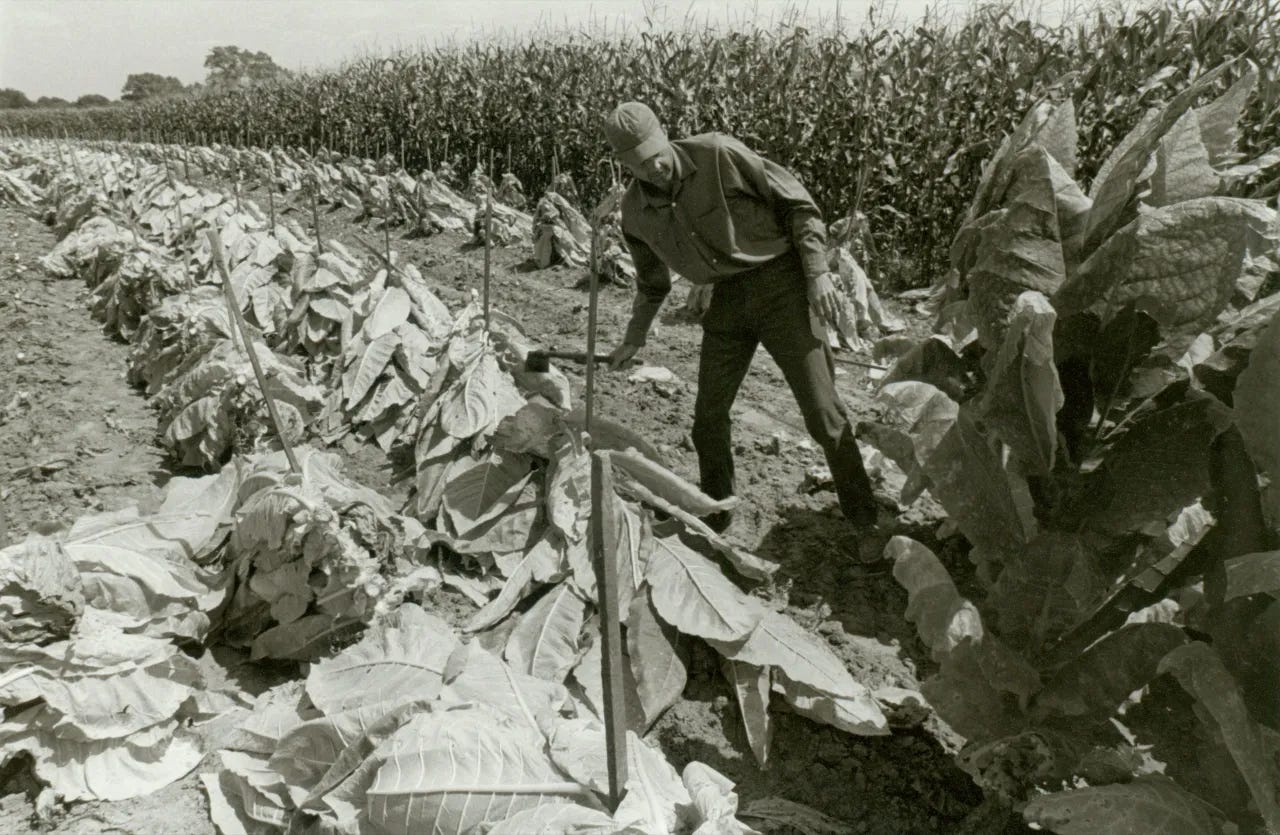
I come, in conclusion, to the difference between “projecting” the future and making a promise. The “projecting” of “futurologists” uses the future as the safest possible context for whatever is desired; it binds one only to selfish interest. But making a promise binds one to someone else’s future. If the promise is serious enough, one is brought to it by love, and in awe and fear. Fear, awe, and love bind us to no selfish aims, but to each other. And they enforce a speech more exact, more clarifying, and more binding than any speech that can be used to sell or advocate some “future.” For when we promise in love and awe and fear there is a certain kind of mobility that we give up. We give up the romanticism of progress, that is always shifting its terms to fit its occasions. We are speaking where we stand, and we shall stand afterwards in the presence of what we have said.
— Wendell Berry, Standing by Words
This Sunday at 11 am Mountain, I’m sitting with patrons to explore two essays by poet, novelist, and farmer Wendell Berry. I hope you’ll join us. (Members, check your email tomorrow, or the Discord server now, for details on that call.)
Below, I offer a somewhat-rushed short riff on why.
If you don’t have time to read the essays before Sunday, here’s a marvelous discussion with Berry from the CBC series “How To Think About Science” that will suffice to prime you. Read the rest at your own leisure. You’ll be glad you did.
At the bottom of this post you’ll find some of my favorite excerpts from the essays we’ll discuss. Feel free to skip on down and soak them up immediately, and then double back to click the links.
Some Context
At first glance, Berry might seem like an unusual focal point for a project that spends so much time making sense of how to live alongside precisely the kind of advanced computer technologies he himself has stubbornly rejected. In 2026, he still refuses to use email, and the book I want to talk about goes on at length about the harms inflicted on both land and soul by…tractors. But Humans On The Loop is, at its core, about what to do when we realize the built environment is every bit as wild and mysterious as the world that modernity believes technology could conquer. We walk a tightrope here between the understanding that abstraction has its place and recognizing that abstraction ends in placelessness—that our models never capture or control the full dimensionality of life, and in favoring abstraction and specialization over the humility of place-based knowledge, we externalize the costs of progress. But externalizing them does not make them go away. Likewise, sweeping pro- and anti-tech positions both fail the wisdom test by violently reducing life’s complexity and thus preventing
Berry, whom I’d like to note was part of William Irwin Thompson’s Lindisfarne Association and thus played a huge part in the conversations that shaped how I think about the future, does a better job than almost anyone of helping ground discussions of technology and science in The Real. In his 1983 collection Standing by Words (available for purchase at Bookshop.org and digital library loan at Archive.org), he scathingly critiques the euphemistic risk-assessment language of The Nuclear Regulatory Commission, the reduction of ecosystem health into economic growth curves by Big Agriculture, and the adulto-lescent romantic individualism of poets like Percy Shelley. But he never strikes me as a “Luddite” in the colloquial sense of the term—not someone who rejects technology as a reflex. Berry is a deeply learned scholar with a profound insight into systems of systems that enables him to recognize the tradeoffs so many other people never even notice.
In C. Thi Nguyen’s latest book The Score: How to Stop Playing Somebody Else’s Game, Nguyen cites historian of science Lorraine Daston’s taxonomy of decision-making systems and their changes over time as society became increasingly regulated by industrial standardization. Principles require personal judgment and sensitivity to subtle fluctuations in inputs, understanding how to move through a large possibility-space. Models (like “What Would Jesus Do?) give us rules to follow based on internalizing other people’s stories and behavior. Algorithms, however, strip the context of principle- or model-based decision-making in favor of mechanical rules that can be strictly replicated by anyone, regardless of expertise, under identical conditions. Berry’s refusal to use computers isn’t “a matter of principle” in the way people so often make what are actually mechanical judgments about what constitutes a machine: automatically reject if, as computing pioneer Alan Kay puts it, the object in question is “Anything that was invented after you were born.” The irony here is that this is algorithmic thinking. But Berry’s discernment is, in Daston’s sense of the word, principled; it comes from close living and attunement to a cosmos of nested open systems, concern for propriety, context:
How appropriate is the tool to the work, the work to the need, the need to other needs and the needs of others, and to the health of the household or community of all creatures?
Reading his work is an experience similar to those induced by Tyson Yunkaporta’s Right Story, Wrong Story, except that this Indigenous wisdom is coming from within (broadly speaking) my own society and ethnic group. Both call for a return to place and community, right speech and action in alignment with The Law of The Land, a reawakening to “premodern” cosmology in which humans exist embedded in and not on top of a more-than-human order. But Yunkaporta is tormented in a way I find uncomfortably familiar, always grappling with how to live with Right Story amidst Wrong Story, to honor his commitments to clan and custodial lifeway from within the colonizer’s world that severed his people from their ancestral land. Berry, by contrast, demonstrates no such inner turmoil. Yes, his family lose their farm due to the depredations of James B. Duke’s American Tobacco Company, a formative rupture you feel viscerally in his lifelong defense of small farms. And yet he makes none of the effort Yunkaporta does, or I do, to make peace with The Big Machine.
If I were more cynical, I’d say his generation had the privilege of opting out. But that isn’t fair, or right. His family made a very hard decision not to try and “plow their way out of debt” and dedicate themselves to soil conservation, because they knew the house would always win. And that decision to play the infinite game of land stewardship instead of the finite game of market competition was and is an act of love. As he puts it in his 2012 Jefferson Lecture:
My effort to make sense of this memory and its encompassing history has depended on a pair of terms used by my teacher, Wallace Stegner…thought rightly that we Americans, by inclination at least, have been divided into two kinds: “boomers” and “stickers.” Boomers, he said, are “those who pillage and run,” who want “to make a killing and end up on Easy Street,” whereas stickers are “those who settle, and love the life they have made and the place they have made it in.” “Boomer” names a kind of person and a kind of ambition that is the major theme, so far, of the history of the European races in our country. “Sticker” names a kind of person and also a desire that is, so far, a minor theme of that history, but a theme persistent enough to remain significant and to offer, still, a significant hope.
Stickers…are motivated by affection, by such love for a place and its life that they want to preserve it and remain in it.
Berry isn’t free from the inescapable tensions I read more explicitly in Yunkaporta, or feel in my own life and the lives of those around me. He just seems to have embraced them. So ultimately, even though I am the sort of person who interrogates the boundary that Berry draws between “organic” and “mechanical”, I identify with him as someone who sees salvation in “sticking” with insoluble problems. If, as he puts it in the final essay of Standing by Words, living on the land is like getting married—a relationship that starts in the romantic promise of what could be and matures into a humbling encounter with what is—then I am married to the generational challenges I share with Yunkaporta, and in Berry’s writing I find hope that living with these challenges, instead of trying to solve them, is the best (and, really, only) path.
Part of this path is in recognizing that specialization may feel like a practical necessity, but the expertise that it enshrines leads us out of touch with the web of interbeing within which even specialist language arises and upon which saying or doing anything meaningful depends.
From the opening essay in this collection, on “The Specialization of Poetry”:
The primary aspect of specialization is practical; the specialist withdraws from responsibility for everything not comprehended by his specialty. Each specialization, Ransom says, “has had to resist the insidious charms of aesthetic experience before its own perfection could arise.” But this is a perfection of a kind never before contemplated in human history—a perfection that depends upon the abandonment of all the old ideals of harmony, symmetry, balance, order, in favor of the singular totalitarian ideal of control, which is typically achieved by leaving out or discounting or destroying whatever is not subject to control. Our achievement of this sort of control over certain particles of the Creation has given rise to the supposition that such control is possible on a much grander scale, which would permit us to bring nature and history into line with our intentions. [W]e are every day surrounded by more evidence of its futility. Human control on any grand scale is impossible, and the technological and political controls that are possible are frequently the opposite of order; any viable human order must come to terms with the impossibility of absolute control.
Responsible speech and action requires even greater discipline than we get within “the disciplines”—or at least, in the modern sense that they have degenerated to professions, and then careers—a dedication to seeing relationships as fundamental:
I find impossible to believe that song can come from, or lead to, Isolation. If a poet says, "I vnto my selfe alone will sing," as Spenser does at the beginning of his "Epithalamion," he can only mean that he does so in anticipation of accompaniment or at least of company. A poet who felt assured that he sang to himself alone would soon find his song lapsing diffidently into a "not overly excited discourse" on the subject of isolation, guilt, suf-fering, death, and oblivion-the self-exploiting autobiography of disconnected sensibility.
But in giving up the quest for power-over, we recover from the alienation of the modern myth that we are individual. From the titular essay in this collection:
If one wishes to promote the life of language, one must promote the life of the community—a discipline many times more trying, difficult, and long than that of linguistics, but having at least the virtue of hopefulness. It escapes the despair always implicit in specializations: the cultivation of discrete parts without respect on responsibility for the whole.
In giving up the illusion of absolute knowledge or control, we are finally free to act. But we are also finally able to really think. Modern scientific knowledge is provisional and insists on separating “theory” from “practice.” Although philosophers of science Ian Hacking and Andrew Pickering argue with authority that this is nonsense, the myth persists because believing it releases theorists from the responsibility of saying anything conclusive and “men of action” from having to consider the consequences of their actions. Likewise, modern philosophy and art both reject utility—and Berry spends much of this book criticizing this behavior as a dereliction of duty:
I do not believe that it is possible to act on the basis of a “tentative” or “provisional” conclusion. We may know that we are forming a conclusion on the basis of provisional or insufficient knowledge—that is a part of what we understand as the tragedy of our condition. But we must act, nevertheless…
…and in acknowledging the fundamentally uncertain while taking back responsibility for action, we can begin to reconnect the disciplines, re-integrate the “internal accounting” of cost and benefit with human enterprise with the “external accounting” of cost and benefit to our entire biosphere:
Neither the known truth nor the mystery is internal to any system. And here, however paradoxical it may seem, we begin to see a possibility of reliable accounting and of responsible behavior. The appropriateness of words or deeds can be determined only in reference to the whole “household” in which they occur. But this whole, as such, cannot enter into the accounting. (If it could, then the only necessary language would be mathematics, and the only necessary discipline would be military.) It can only come in as mystery: a factor of X which stands not for the unknown but the unknowable. This is an X that cannot be solved—which may be thought a disadvantage by some; its advantage is that, once it has been let into the account, it cannot easily be ignored. You cannot leave anything out of mystery, because by definition everything is always in it.
By honoring the mystery we put human action back in its right place in the living world—not with an all-engulfing holism but with humility:
This does not mean that a reliable account includes the whole system of systems, for no account can do that. It does mean that the account is made in precise reference to the system of systems—which is another way of saying that it is made in respect for it. Without this respect for the larger structures, the accounting shrinks into the confines of some smaller structure and becomes specialized, partial, and destructive.
It is this sort of external accounting that deals with connections and thus inevitably raises the issue of quality. Which, I take it, is always the same as the issue of propriety…
Which brings us again to the heart of Berry’s work, and the heart of this project’s inquiry. If we are to meet power with wisdom, we have to ask about the quality of the work we seek to accomplish with awesomely powerful tools. We need to restore our values while living in a world that has restricted our vision to matters of value.
The following passage is worth quoting twice:
How appropriate is the tool to the work, the work to the need, the need to other needs and the needs of others, and to the health of the household or community of all creatures?
In other words, this nonagenarian poet-farmer makes for surprisingly perfect reading on the question of right living in “The Age of AI.” What, if anything, does a planet-scale automated economy look and feel like if it is capable of “sticking” with these questions? Mustn’t any Artificial Super-Intelligence worth its name be at least as principled as Berry, at least as nuanced in its reflections on propriety?
I can’t do justice to the subtlety and erudition of his work—especially while I’m trying to walk my talk and not ignore my children on a Friday night—so let me just share some more great passages, below. Berry’s words have dirt under their fingernails. They elevate the philosophical discussions I’m so fond of—why culture is the lifeblood of economy, how Reality exists in excess of all language, why optimization is a false god, and so on—to the realm of political action, and transdisciplinary exploration to an act of loving service.
Again, I hope you’ll join us to discuss his work this Sunday. We’ll record it if you can’t be there…and either way, you can expect more Berry on this channel in the months and years to come. Consider this an IOU.
PS — These essays pair extremely well with philosopher C. Thi Nguyen’s latest book, The Score: How to Stop Playing Somebody Else’s Game, which he and I will talk about on the podcast very soon.
I warmly invite you to stick around for that.
Excerpts from “The Specialization of Poetry”
What we call the modern world is not necessarily, and not often, the real world, and there is no virtue in being up-to-date in it. It is a false world, based upon economies and values and desires that are fantastical—a world in which millions of people have lost any idea of the materials, the disciplines, the restraints, and the work necessary to support human life, and have thus become dangerous to their own lives and to the possibility of life. The job now is to get back to that perennial and substantial world in which we really do live, in which the foundations of our life will be visible to us, and in which we can accept our responsibilities again within the conditions of necessity and mystery. In that world all wakeful and responsible people, dead, living, and unborn, are contemporaries. And that is the only contemporaneity worth having.
What is needed is work of durable value; the time or age of it matters only after the value has been established.
In itself, protest implies no discipline and no correction… In his protest, the contemporary poet is speaking publicly, but not as a spokesman; he is only one outraged citizen speaking at other citizens who do not know him, whom he does not know, and with whom he does not sympathize.
Perhaps the time has come to say that there is, in reality, no such choice as Yeats’s “Perfection of the life, or of the work.” The division implied by this proposed choice is not only destructive, it is based upon a shallow understanding of the relation between work and life. The conflicts of life and work, like those of rest and work, would ideally be resolved in balance: enough of each. In practice, however, they probably can be resolved (if that is the word) only in tension, in a principled unwillingness to let go of either, or to sacrifice either to the other. But it is a necessary tension, the grief in it both inescapable and necessary. One would like, one longs in fact, to be perfect family man and a perfect workman. And one suffers from the inevitable conflicts. But whatever one does, one is not going to be perfect at either, and it is better to suffer the imperfection of both than to gamble the total failure of one against an illusory hope of perfection in the other. The real values of art and life are perhaps best defined and felt in the tension between them. The effort to perfect work rises out of, and communes with and in turn informs, the effort to perfect life, as Yeats himself knew and as other poems of his testify. The use of life to perfect work is an evil of the specialized intellect. It makes of the most humane of disciplines an exploitive industry.
Excerpts from “Standing by Words”
I will use a pair of economic concepts: internal accounting, which considers costs and benefits in reference only to the interest of the money-making enterprise itself; and external accounting, which considers the costs and benefits to the “larger community.” By altering the application of these terms a little, any statement may be said to account well or poorly for what is going on inside the speaker, or outside him, or both.
It will be found, I believe, that the accounting will be poor—incomprehensible or unreliable—if it attempts to be purely internal or purely external. One of the primary obligations of language is to connect and balance the two kinds of accounting.
There can be little doubt, I think, that any accounting that is purely internal will be incomprehensible. If the connection between inward and outward is broken—if, for instance, the experience of a single human does not resonate within the common experience of humanity—then language fails. In The Family Reunion, Harry says: “I talk in general terms/Because the particular has no language.” But he speaks, too, in despair, having no hope that his general terms can communicate the particular burden of his experience. We readily identify this loneliness of personal experience as “modern.” Many poems of our century have this loneliness, this failure of speech, as a subject; many more exhibit it as a symptom.
The notion that external accounting can be accomplished by “objectivity” is an illusion. Apparently the only way to free the accounting of what is internal to people, or subjective, is to make it internal to (that is subject to) some other entity or structure just as limiting, or more so—as the commissioners attempted to deal with a possible public catastrophe in terms either of nuclear technology or of public relations. The only thing really externalized by such accounting is a bad result that one does not wish to pay for.
To be bound within the confines of either the internal or the external way of accounting is to be diseased. To hold the two in balance is to validate both kinds, and to have health. I am not using these terms “disease” and “health” according to any clinical definitions, but am speaking simply from my own observation that when my awareness of how I feel overpowers my awareness of where I am and who is there with me, I am sick, diseased. This can be appropriately extended to say that if what I think obscures my sense of whereabouts and company, I am diseased. And the converse is also true: I am diseased if I become so aware of my surroundings that my own inward life is obscured, as if I should so fix upon the value of some mineral in the ground as to forget that the world is God’s work and my home.
So long as the smaller systems are enclosed within the larger, and so long as all are connected by complex patterns of interdependency, as we know they are, then whatever affects one system will affect the others.
It seems that this system of systems is safe so long as each system is controlled by the next larger one. If at any point the hierarchy is reversed, and the smaller begins to control the larger, then the destruction of the entire system of systems begins. This system of systems is perhaps an updated, ecological version of the Great Chain of Being. That is, it may bring us back to a hierarchical structure not too different from the one that underlies Paradise Lost—a theory of the form of Creation which is at the same time a moral form, and which is violated by the “disobedience” or hubris of attempting to rise and take power above one’s proper place.
But the sketch I have made of the system of systems is much too crude, for the connections between systems, insofar as this is a human structure, are not “given” or unconscious or automatic, but involve disciplines. Persons are joined to families, families to communities, etc., by disciplines that must be deliberately made, remembered, taught, learned, and practiced.
The system of systems begins to disintegrate when the hierarchy is reversed because that begins the disintegration of the connecting disciplines. Disciplines, typically, degenerate into professions, professions into careers.
PS — If you’re new here or have been absorbed in other matters, here are some related pieces that might shake your thinking loose:
📖 Prophetic Culture Book Club Recording

I recently met with insightful friends Jeremy Johnson, James Curcio, Paul Bloch, Kevin DeLand, and Jay Bachhuber, to play mind-jazz on the themes of Federico Campagna’s marvelous book Prophetic Culture: Recreation for Adolescents.
✨Refactoring “Autonomy” & “Freedom” for The Age of Language Models

“I was on a panel earlier this year with Geoffrey Hinton. He said, ‘We can’t let AIs manipulate us.’ I told him, ‘That ship sailed ten years ago! The question is, in what way do we want them to manipulate us?’”

Matt Segall on Culture as The Lifeblood of The Machine Economy

This week I dialogue with Matthew David Segall, Associate Professor of Philosophy, Cosmology, and Consciousness at the California Institute of Integral Studies, Chair of the Science Advisory Committee for the Cobb Institute, and author of the Footnotes To Plato blog as well as numerous books on the philosophy of Alfred North Whitehead and Friedrich Sche…
Scale Theory: Contemplating Everything-At-Onceness with Joshua DiCaglio

This week’s guest my friend Joshua DiCaglio, Associate Professor of English at Texas A&M University and author of the fabulous Scale Theory: A Nondisciplinary Inquiry.