
✨ Become a founding member to access my online courses, including Jurassic Worlding and How To Live In The Future
✨ Browse and buy all of the books we discuss on the show at Bookshop.org
✨ Stream and download my music at artist-owned Subvert.fm
✨ Learn about Atlas Research Group, my new team on a mission to build sovereign infrastructure for social coherence and collective intelligence
About This Episode
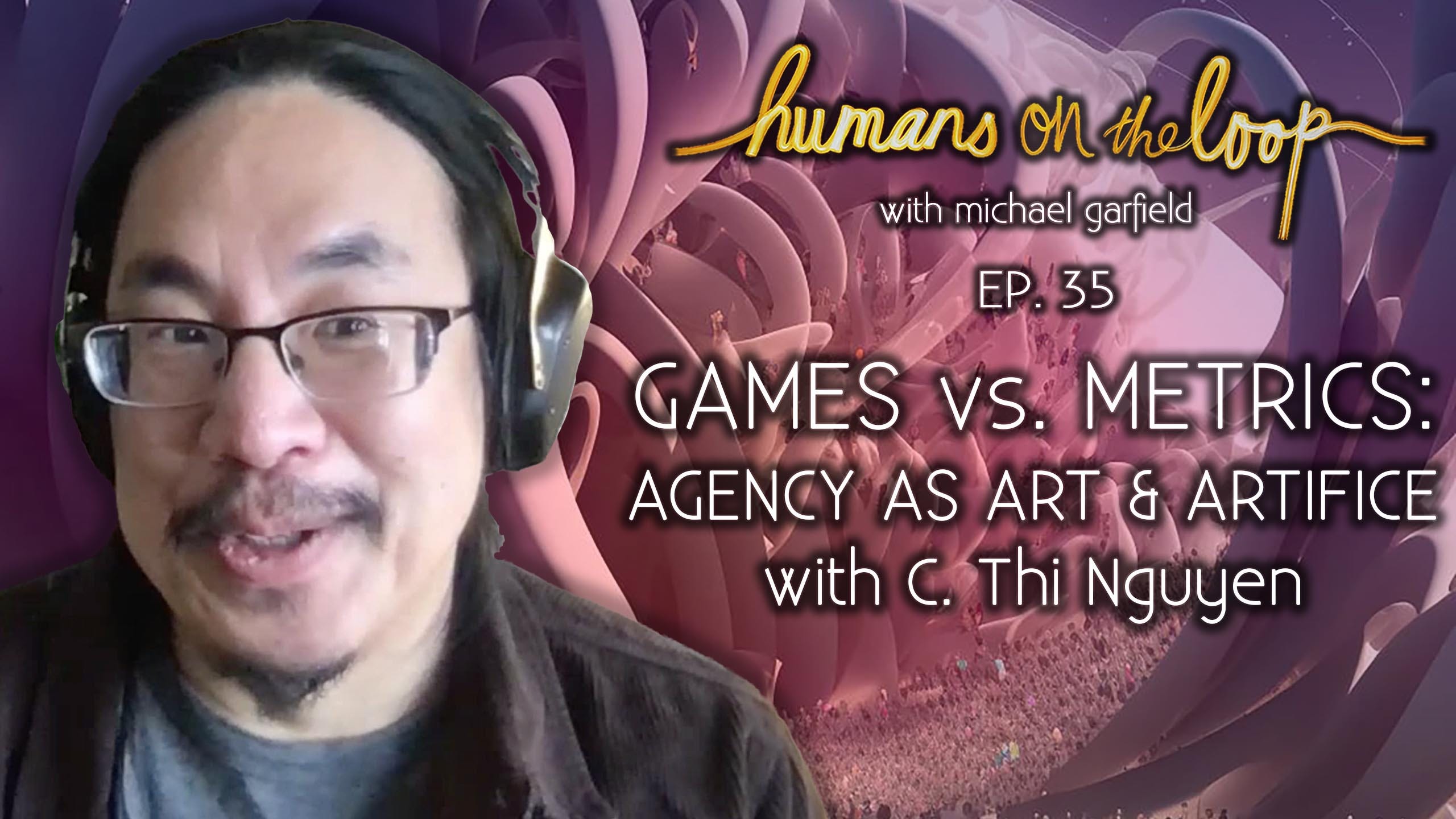
This week’s guest is C. Thi Nguyen (Website | Wikipedia | X), associate professor of philosophy at the University of Utah and a specialist in the philosophy of games, the philosophy of technology, and the theory of value. In our first conversation on Future Fossils, we explored his writing on games as an art form in which agency is the medium. His new book, The Score: How to Stop Playing Somebody Else’s Game, takes that logic further and reveals the games that bind society together with institutional metrics — one of the most powerful, pervasive, and invisible technologies of all time.
Thi’s thesis hinges on the observation that a metric is never just a number. It’s a value judgment dressed up in the costume of objectivity, a down-sampling of our richly multidimensional world into proxies that can travel efficiently between strangers. And with every subsequent compression of meaning into portable, scalable, decontextualized form, our metrics progressively displace place itself — the nuance of our singular, non-fungible lives — and define what we can even aspire to be.
Thi calls this kind of cognitive enclosure “value capture”: when an institution uses metrics to coordinate across distance and difference, it engineers a context-invariant kernel that can travel between strangers without requiring shared background, history, or care. The power of these abstractions is real. So is their violence.
We can use metrics instrumentally, holding them lightly as useful fictions. But more often than not we forget things like GPA, GDP, or KPIs started life as somebody else’s choices — that someone, somewhere, decided what to count and what to ignore — and we begin to inhabit the metric as if it were reality itself: optimizing our lives, desires, and identities for a scoring system we didn’t author and may never have consciously accepted.
Games show us another way. By Thi’s account, games are a medium for the transmission of different kinds of agency, a technology for practicing the very awareness that metrics erode: that metrics are cultural constructs, and we still have some choice in what to value. When you’re playing, you know you’re playing. The magic circle of the game space is a low-stakes laboratory for inhabiting a different set of values, and therefore different selves. Therein lies a whole philosophy of freedom, and in a moment when the infrastructure of meaning-making is being rebuilt from the ground up, recovering our capacity to see the game of modern life as a game may be the most important skill we have.
But there’s a twist that takes us beyond the scope of Thi’s book and into the question that’s been keeping me up at night for the last two years. With AI, we’ve tunneled so far into abstraction that we may have come out the other side. Large language models now allow us to translate between different perspectives, to ground insights from our aggregate intelligence in personal detail. If you’ve ever used a chatbot to explain physics to you as a specific human being, based on your own data vault, and in the style of a specific author, you know what I mean. Socrates’ critique of written language in Phaedrus — that it couldn’t “read the room” or know its audience — feels somewhat less relevant in an age when the generation of text is powered by systems with such a high-dimensional and granular view of things that we are no longer bound to one canonical version of anything. Is AI the apotheosis of our enclosure by institutional metrics, or is it the medium through which we are finally able to take a post-ironic stance on the constraints of modern life?
It’s starting to look like a world in which everything is a metric and everything is a game. And just maybe, that means we can renegotiate these tradeoffs…as long as we don’t take ourselves too seriously.
And with this, we circle back around to the core question of this project: As we approach the horizon where anything is possible, what should be? Who do you want to be, and what games will make you that person?
Chapters
00:00 Episode Teaser
03:50 Intro Monologue
09:11 Meet C. Thi Nguyen
17:43 Value Capture Explained
23:48 The Gap between Measured & Valued
35:29 Recognition vs. Perception
42:48 Games vs. Institutions
46:43 Is Meaning Control an Interface Problem?
49:09 How Rules Became Algorithms
54:17 Fungibility & Monocropping
56:38 Is Coordination at Scale a Red Herring?
01:03:14 Art Provides Hope
01:16:17 AI Futures & Values
01:32:27 Thanks & Announcements
Mentioned Resources
Are humans destined to evolve into crabs? by Michael Garfield
Coarse-graining as a downward causation mechanism by Jessica Flack
The Computer as a Communication Device by J.C.R. Licklider and Robert Taylor
Paul Smaldino & C. Thi Nguyen on Problems with Value Metrics & Governance at Scale (EPE 06) for Complexity Podcast
The natural selection of bad science by Paul Smaldino & Richard McElreath
Slowed canonical progress in large fields of science by Johan Chu & James Evans
Jargon is a Moat by Second Voice
Trust in Numbers by Theodore Porter
Rules by Lorraine Dastin
Seeing Like A State by James C. Scott
The Power of Maps by Dennis Woods
Dilla Time by Dan Charmas
Metaphors We Live By by George Lakoff & Mark Johnson
Marshall McLuhan
Reiner Knizia
Langdon Winner
Samantha Matherne
Iain McGilchrist
Kevin Kelly


